1. How would you describe the current state of diplomatic relations between the Dominican Republic and South Africa?
The Dominican Republic and South Africa enjoy a positive and steadily evolving diplomatic relationship, grounded in mutual respect, shared values, and a common vision for cooperation among countries of the Global South. While geographically distant, both nations have demonstrated a clear interest in strengthening ties and expanding areas of collaboration.
In recent years, there has been renewed momentum in the relationship, reflected in increased political dialogue and growing interest in advancing cooperation across key sectors. Both countries recognise the importance of building a more structured and dynamic partnership that responds to current global challenges and creates new opportunities for engagement.
This relationship is also supported by a broader commitment to multilateralism and South–South cooperation, where both countries often share perspectives on issues such as sustainable development, inclusion and international collaboration.
As this relationship continues to evolve, it offers a meaningful opportunity to build a partnership that is both dynamic and rooted in shared values, and a growing connection between our peoples.
2. Trade between the two countries remains largely underexplored. What key opportunities do you see for expanding bilateral trade in the coming years?
South Africa and the Dominican Republic have complementary economies, creating meaningful opportunities to expand bilateral trade. While current exchanges remain modest, there is still significant untapped potential.
The Dominican Republic offers a stable and competitive business environment, supported by its strategic location as a hub connecting the Caribbean, North America and Latin America, as well as a strong network of free trade zones and access to key international markets. South Africa, in turn, brings significant industrial capacity and serves as a gateway to the African continent.
Current trade flows already reflect this complementarity. The Dominican Republic exports manufactured goods such as medical and pharmaceutical products, as well as electrical and technical equipment. South Africa contributes industrial inputs and manufactured goods, including aluminium, automotive components and machinery. This creates opportunities to further integrate into value chains and build more complementary production linkages between both economies.
One of the main challenges remains geographical distance, particularly in terms of connectivity. Strengthening transport links and facilitating more efficient routes will be important. In this regard, we are exploring opportunities with partners in the aviation sector to improve connectivity between the Caribbean and Southern Africa.
There is also room to expand the presence of emblematic Dominican products in the South African market. Premium cigars and Dominican rum offer clear opportunities for growth, alongside products such as coffee and cacao.
3. The Dominican Republic is internationally recognised as a premier tourism destination. Which experiences or offerings do you believe would resonate most strongly with South African travellers?
The Dominican Republic offers a diverse tourism experience that goes far beyond the traditional image of Caribbean sun-and-beach tourism. For South African travellers, one of the most appealing aspects is the variety of experiences available within a relatively small territory.
Visitors can enjoy pristine beaches, as well as mountain landscapes, waterfalls, national parks and rich biodiversity, which have supported the growth of ecotourism and nature-based experiences. The country has also developed strong niche segments such as golf tourism, with world-class courses combined with high-quality hospitality.
Equally important is the cultural and historical dimension. Santo Domingo, the capital, is the oldest city in the Americas and home to several historic firsts, including the first cathedral, university and hospital in the New World. Dominican gastronomy, music and traditions reflect the encounter of Taíno, African and Spanish influences, offering visitors a rich and immersive cultural experience, where the warmth and hospitality of the Dominican people remain one of the most memorable aspects of any visit.
In 2025 alone, the country welcomed more than 11.6 million visitors, consolidating its position as the leading tourism destination in the Caribbean and the second most visited in Latin America.
I hope that, in the near future, many South African travellers will have the opportunity to experience what makes our country so distinctive.
4. Cultural diplomacy plays an important role in strengthening international relations. Are there plans for cultural exchanges, festivals, educational partnerships, or artistic collaborations that bring Caribbean and African cultures closer together?
The Dominican Republic and South Africa share deep historical and cultural links rooted in Africa. As Dominican historian Celsa Albert Batista has highlighted, the African presence in the Dominican Republic dates back to the earliest periods of the Americas and has shaped our national identity in lasting ways. This legacy is reflected in our music, gastronomy, traditions and in the way we understand community.
Since our arrival in South Africa, cultural promotion has been a consistent part of our diplomatic agenda, as we seek to strengthen not only government-to-government relations, but also the ties between our peoples.
Our efforts focus on promoting cultural exchanges, including artistic collaborations and partnerships between academic and creative institutions, as well as internship opportunities for both South African and Dominican students.
This has included participation in key events such as Africa Day and initiatives linked to the African diaspora, particularly within the framework of the Sixth Region, which offer valuable spaces for connection and dialogue. We have also taken part in film and gastronomy festivals in coordination with fellow GRULAC countries.
Building on this work, we are planning a programme of activities to mark the 25th anniversary of diplomatic relations next year, with a strong cultural component to further deepen these ties.
Cultural diplomacy is ultimately about strengthening mutual understanding, reconnecting with a shared history, and building a future in which our peoples recognise one another as part of a common story.
5. Could you share highlights from your political and diplomatic career, and what inspired you to pursue a path in public service and diplomacy?
Over the course of my 28-year diplomatic career, I have served in a range of roles that have shaped my understanding of international relations and public service, while progressively taking on greater responsibilities. My work has taken me across Europe, North America and multilateral settings, allowing me to engage with diverse perspectives and contribute to strengthening the Dominican Republic’s international presence.
I was drawn to diplomacy by a strong interest in international engagement and the opportunity to represent my country beyond its borders. I was particularly inspired by the role diplomacy plays in fostering dialogue, building trust and creating spaces for cooperation. Over time, that initial motivation evolved into a deeper sense of purpose.
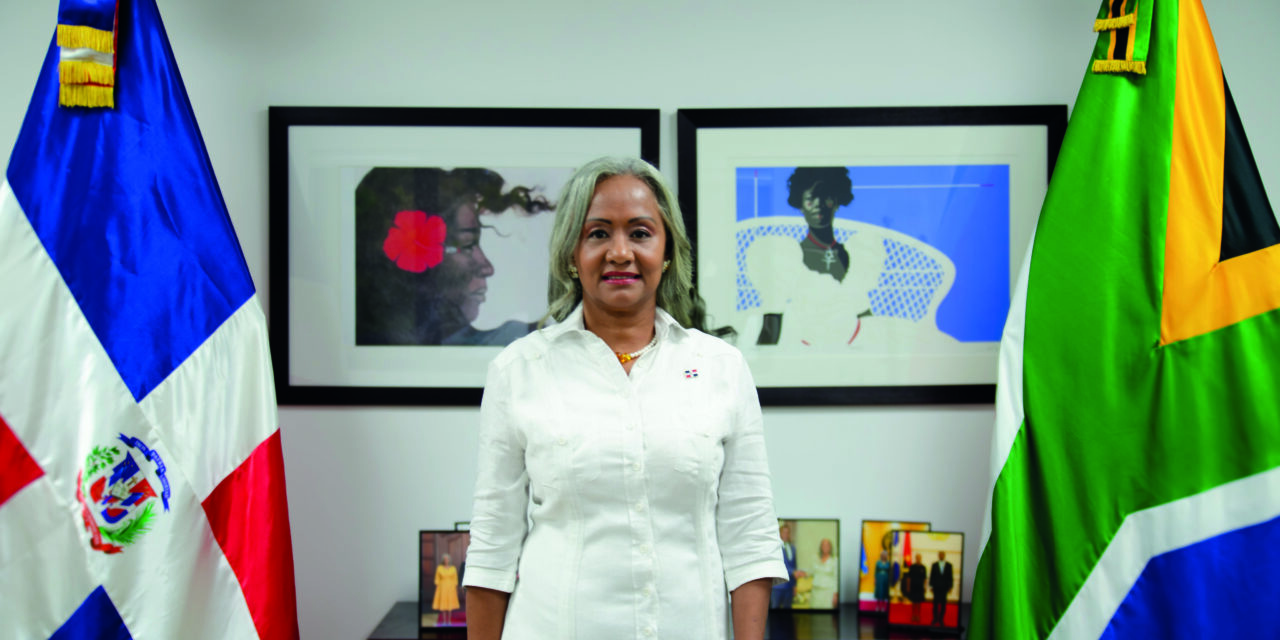
Today, serving as Ambassador of the Dominican Republic to South Africa is both an honour and a profound responsibility. Representing my country in a nation shaped by the legacy of Nelson Mandela carries particular meaning and reinforces my commitment to dialogue, inclusion and the strengthening of ties between our peoples.
As a woman in diplomacy, I am deeply conscious of the importance of opening doors for future generations, and I hope that my journey can serve as an example to young women and girls that leadership and public service are real and attainable paths.
6. Since assuming your post in South Africa, what has been the most rewarding aspect of your assignment, and what challenges have provided valuable lessons?
Serving in South Africa has been both professionally enriching and personally meaningful. It has given me the opportunity to engage with a country whose resilience, diversity and global outlook are striking, while contributing to the strengthening of a relationship with significant potential.
Serving as the first woman to represent my country here also adds a strong sense of responsibility. Being in Africa brings a greater awareness of shared histories and connections and reinforces the importance of promoting in the Dominican Republic a more accurate and nuanced understanding of the continent.
Another aspect that has left a deep impression on me is the philosophy of Ubuntu, with its emphasis on our shared humanity. Its understanding of community, dignity and solidarity resonates strongly with values that are also present in Dominican society.
Like any diplomatic assignment, this one has also brought challenges, particularly when working to bring closer together societies that are still getting to know one another. This has underscored the importance of consistency, patience and sustained engagement.
This experience has shown that diplomacy is, above all, about people, about understanding, connection, and the ability to bring societies closer together in meaningful and lasting ways.
7. How do you see South–South cooperation evolving between Latin America, the Caribbean, and Africa, particularly in the current global context?
In today’s shifting geopolitical landscape, there is a clear movement toward more diversified and balanced partnerships. As global dynamics become more complex, countries across the Global South are increasingly seeking to strengthen cooperation among themselves to expand opportunities while ensuring their voices are better reflected in global decision-making.
This creates an important opportunity to deepen collaboration between Latin America, the Caribbean and Africa, building on the complementary strengths of our regions. In this context, South Africa plays a particularly important role as a member of the G20 and BRICS, contributing to shaping a more inclusive and balanced global order. Areas such as trade, education and innovation remain key, while tourism has also emerged as a strategic bridge that brings our societies closer together.
Strengthening the Dominican Republic’s presence in Africa is a clear priority. From our Embassy in South Africa, we are working to deepen bilateral ties while expanding engagement across the countries of our concurrent accreditation.
The real opportunity lies in ensuring that this growing engagement translates into tangible initiatives that deliver lasting benefits for our peoples. At its core, this is about turning connection into concrete results — bringing our peoples closer together in ways that are both meaningful and lasting.
8. Finally, what message would you like to share with South Africans who may be curious about the Dominican Republic as a trade partner, travel destination, or cultural ally?
The Dominican Republic is a country that has much to offer and often surprises those who come to know it. It is not only a dynamic and reliable trade partner, but also a nation defined by its people, their cultural richness, creativity and resilience.
For South Africans, there is a connection that goes beyond geography. Our shared roots, and the importance we place on culture, music, gastronomy and community, create a natural basis for mutual understanding and exchange, and position the Dominican Republic as a meaningful cultural ally.
There is real potential to deepen ties through trade, tourism and cultural engagement, strengthening both our economic links and the human connections that sustain them.
I hope that more South Africans will come to know the Dominican Republic not only as a destination or as a market, but as a country and a people with which meaningful and lasting connections can be built.