1. Serbia and South Africa share strong historical ties. What key moments have defined this partnership?
Relations between Serbia and South Africa are deeply rooted in history and shared values. Modern Serbia is the successor state and the largest constituent of the former Yugoslavia, one of the founding members of the Non-Aligned Movement as a global platform for countries seeking independence, sovereignty, and balanced international relations which was established at the historic Belgrade Conference of 1961.
South Africa’s ties with Serbia are particularly grounded in the legacy of Yugoslavia’s active and principled support for the African National Congress during the struggle against apartheid. This solidarity created a foundation of trust and friendship that continues to shape bilateral relations today. Serbia places great importance on South Africa’s consistent support for Serbia’s territorial integrity, including its position on Kosovo and Metohija as a part of Serbia and cradle of Serbian civilization, and its broader commitment to peace, dialogue, and international law.
People-to-people ties also play a significant role. A Serbian diaspora lives and works in South Africa, for more than a century, contributing to economic and cultural life. The Serbian Orthodox Church in Johannesburg, built in 1978, the Saint Sava Serbian School operating under the Serbian Ministry of Education program, and the Serbian Cultural Society “Africa” all serve as pillars for preserving Serbian heritage while strengthening friendship with South Africa.
2. Trade between Serbia and South Africa is growing but remains relatively modest. Which sectors offer the greatest potential for expansion?
There is substantial untapped potential for expanding trade and investment between our two countries. Serbia sits at the crossroads of Southeast and Central Europe. Provides access to EU markets, CEFTA, and countries like Russia and Turkey via trade agreements. Ideal as a manufacturing and logistics hub for companies expanding beyond the EU. Has highly skilled labor, especially in engineering, IT, and manufacturing and strong technical education base. Government offers tax breaks, subsidies for job creation, free zones with customs benefits and corporate tax rate (~15%) is among the lowest in Europe. In Serbia undertaking ongoing reforms aligned with EU accession., and has simplified procedures for starting a business, increasing digitalization and transparency. Major investments in roads, rail, and energy. Key transport corridors (Pan-European corridors) enhance logistics efficiency.
The information technology sector represents major opportunity for cooperation. South Africa has one of the largest IT markets in Africa, particularly in mobile software development, cybersecurity, and digital banking. Serbia’s fast-growing IT sector has the expertise and capacity to enter this market, especially in cloud-based services, e-commerce platforms, smart city technologies, artificial intelligence, and cybersecurity. Serbian experts can support South Africa in developing robust cybersecurity strategies and protecting digital infrastructure.
Infrastructure development also offers strong prospects. Serbian construction companies already have experience building roads and infrastructure in Africa and can participate in major projects in South Africa, including roads, bridges, and urban development. Serbian engineering and design firms can provide high-quality services, while Serbian water-treatment companies can contribute solutions to challenges related to clean water access. Renewable energy cooperation—particularly in solar and wind power—represents another area with long-term strategic value.
Agriculture is one of the most promising sectors. Serbia has a strong tradition in seed production and can export high-quality seeds that are resistant to drought and climate change—an area of increasing importance for South Africa. Maize, as South Africa’s main grain, is a particularly relevant opportunity.
In addition, Serbia can contribute advanced IT solutions for precision agriculture, irrigation management, and agricultural land optimization. Cooperation could also expand into the construction and management of drip irrigation systems, as well as the establishment of facilities for manufacturing agricultural machinery.
3. How impactful has the 2023 Chamber of Commerce agreement been in strengthening economic ties?
The Memorandum of Understanding between the Chambers of Commerce of Serbia and South Africa represents a crucial institutional framework for sustained economic cooperation. It provides a practical mechanism for connecting businesses directly and fostering long-term partnerships.
Through this agreement, the chambers can organize business forums, B2B meetings, trade delegations, and joint participation in international fairs. These activities create opportunities for new export deals, investments, and joint ventures. Equally important, the agreement helps identify sectors with the greatest potential for cooperation and address obstacles that may hinder business activity.
The Serbian Chamber of Commerce is a particularly valuable partner, as membership includes all companies operating in Serbia. This broad representation enables comprehensive engagement across all sectors of the Serbian economy, significantly strengthening the effectiveness of bilateral business cooperation.
Opening of The Serbian Chamber of Commerce Office in Johannesburg, it second on African continent will be important milestone in expending of our future business cooperation.
4. Expo 2027 Belgrade is set to welcome around 130 countries. What does hosting such a major global event mean for Serbia?
Expo 2027 Belgrade, themed “Play for Humanity,” is far more than a three-month exhibition. For Serbia, it is a strategic national project with profound economic, political, and developmental significance. It will be the largest international event ever hosted by the country, welcoming more than 130 countries and over four million visitors during its 93-day duration.
Expo 2027 will position Belgrade as a global hub for diplomacy, business, culture, and innovation. It marks Serbia’s transition from regional visibility to global prominence.
Economically, the Expo is expected to generate billions of euros in activity, driving growth in tourism, hospitality, construction, transportation, and services. It acts as both a short-term economic boost and a long-term catalyst for sustainable development.
The event is already triggering large-scale infrastructure projects, including a new exhibition complex, major transport upgrades, hotels, residential developments, and public facilities. These investments will remain long after 2027, improving quality of life and strengthening Serbia’s economic capacity.
Expo 2027 also serves as a powerful platform for investment, enabling global companies to enter the Serbian market and encouraging foreign direct investment, joint ventures, and export opportunities. Diplomatically, it holds historic significance as the first Expo ever hosted in Southeast Europe and the former Yugoslavia, bringing world leaders, institutions, and businesses to Belgrade.
5. How can young professionals and entrepreneurs from both countries get involved in building stronger ties?
Young professionals from Serbia and South Africa are uniquely positioned to shape bilateral relations—often with greater flexibility and creativity than traditional diplomacy allows. The key is practical collaboration.
Serbia has developed a broad ecosystem of support for young entrepreneurs, combining funding, education, mentoring, and institutional backing. While challenges remain, these initiatives significantly improve the chances for young people to start and grow their own businesses.
Expo 2027 Belgrade represents a once-in-a-generation opportunity. Young professionals can participate by working or volunteering with national pavilions, joining organizing teams, PR agencies, or partner companies, and developing joint Serbia–South Africa business or cultural initiatives around the Expo. It offers unparalleled networking opportunities with global stakeholders.
Beyond large institutions, young entrepreneurs can act as connectors. By creating startup networks, facilitating market entry for Serbian tech companies into Africa and South African companies into the Balkans, and supporting innovation-driven partnerships, they help build future leadership pipelines.
Serbia’s “World in Serbia” scholarship program also plays a key role by bringing students from non-aligned countries including South Africa to study in Serbia, fostering long-term connections.
6. Can you share insights into your diplomatic career and journey to South Africa?
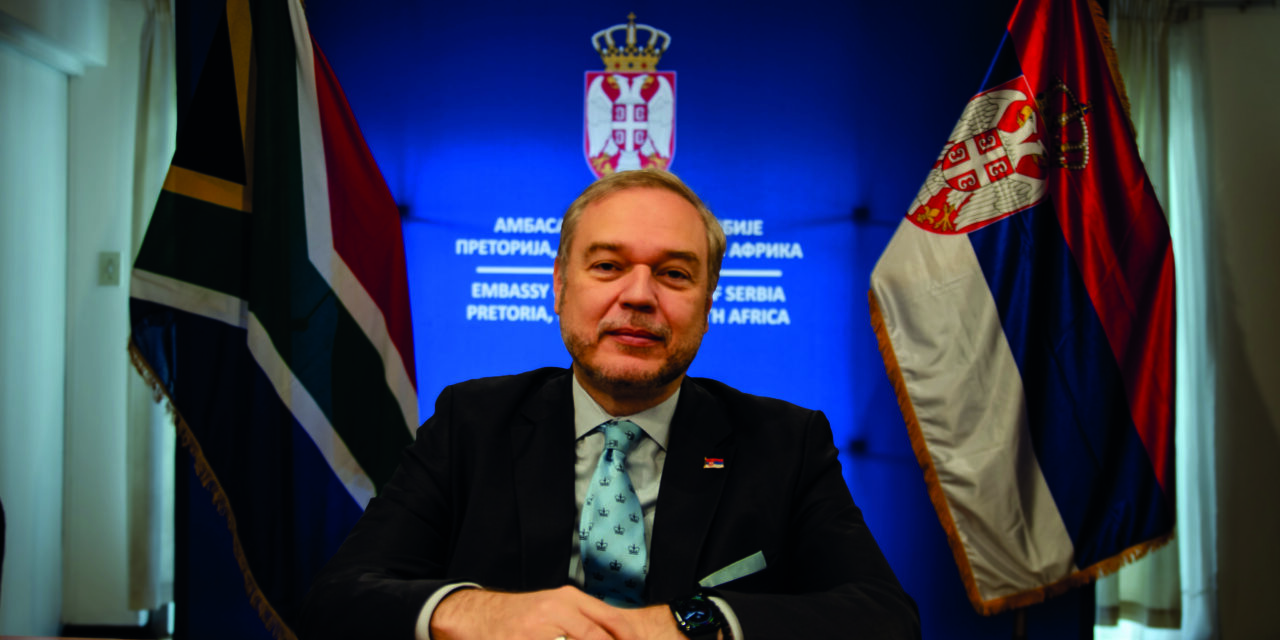
I am very pleased to be back in South Africa. Prior to my appointment as Ambassador Extraordinary and Plenipotentiary of the Republic of Serbia to South Africa in 2025, I served as Chargé d’Affaires ad interim of Serbia’s Permanent Mission to the United Nations and as Acting Deputy Permanent Representative in New York.
Earlier in my career, I served as Deputy Head of Mission and First Counselor at the Serbian Embassy in Pretoria, as well as Chargé d’Affaires ad interim in Nairobi and Acting Permanent Representative to UNEP and UN-Habitat. Since joining the foreign service in 2003, I have held numerous roles within the Ministry of Foreign Affairs, including responsibilities related to the United Nations, climate change, environmental protection, and regional initiatives.
I hold a Master of International Affairs from Columbia University’s School of International and Public Affairs, along with academic qualifications from the Harriman Institute and City University of New York.
7. What has been your most memorable experience in South Africa so far?
South Africa holds a very special place in my heart and in my family’s life. Our younger daughter was born during my previous posting in Pretoria, creating a lifelong personal connection to this country. Over the years, we have built deep friendships that continue to shape our lives and remain strong regardless of where our diplomatic journeys take us.
8. How do you hope to leave a lasting impact on Serbia–South Africa relations?
It is a great honor to represent Serbia in a country as friendly and globally significant as South Africa. I firmly believe that relations between states are built on relations between people. Throughout my diplomatic career, I have focused on fostering strong, honest, and lasting connections.
The historic friendship between Serbia and South Africa, forged during the struggle against apartheid, remains the foundation of our relationship. My goal is to see this friendship grow even stronger—through expanded economic cooperation, deeper people-to-people contacts, and initiatives such as visa-free travel for Serbian citizens to South Africa and enhanced diplomatic presence of South Africa in Serbia at ambassadorial level. These steps will ensure that our partnership continues to flourish for generations to come.